 Save to Pinterest
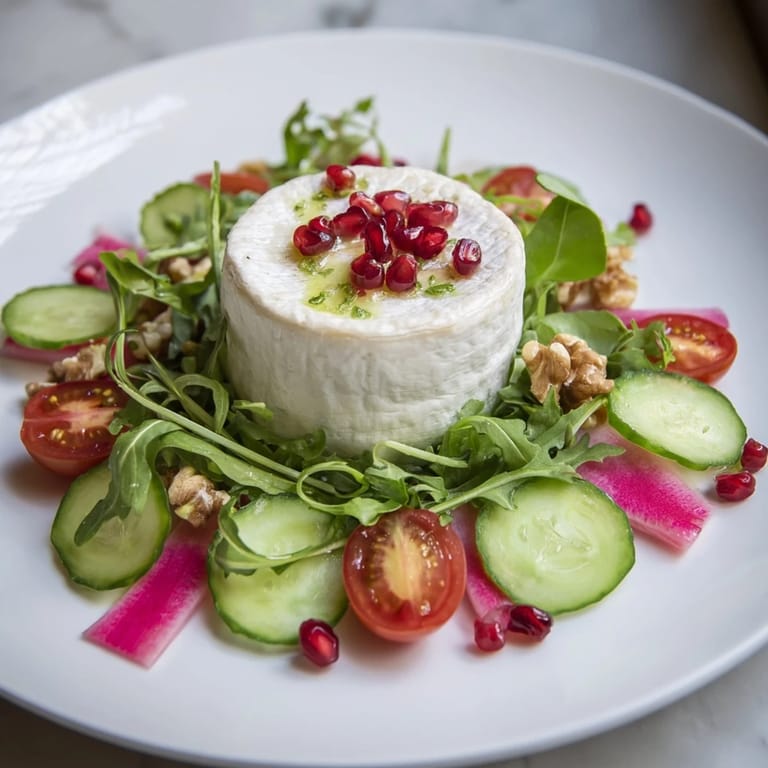
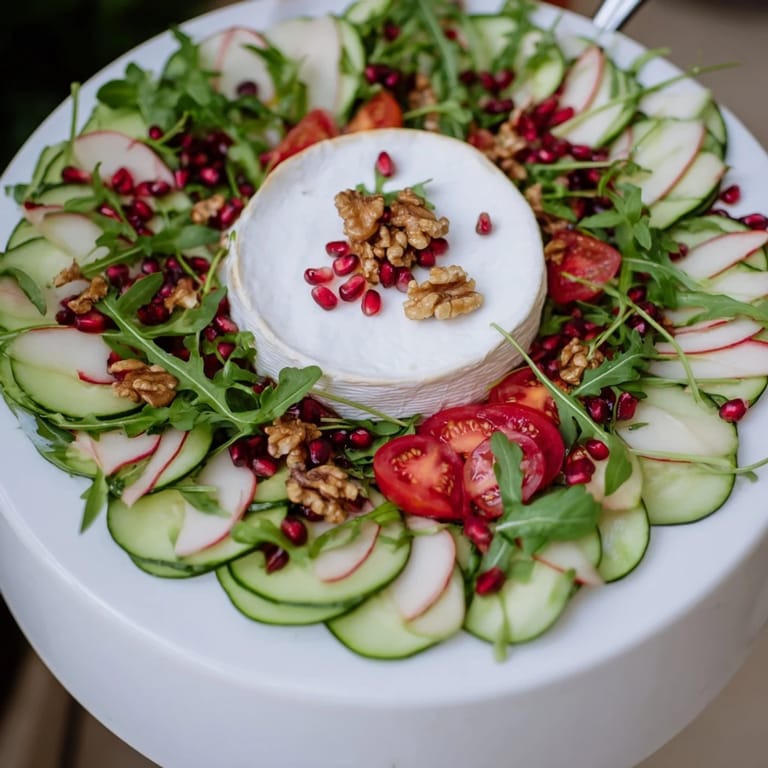
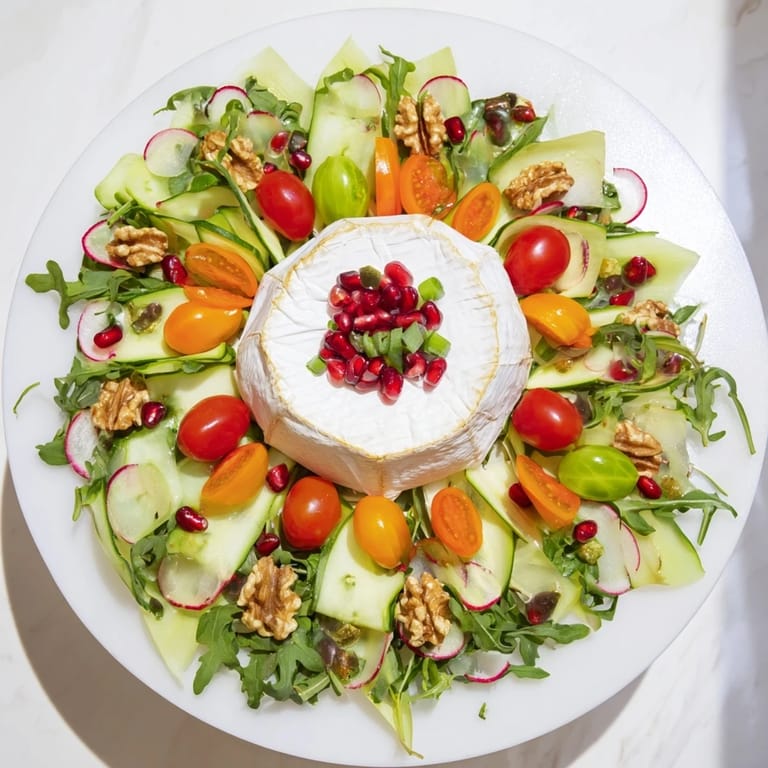
 I discovered this salad by accident while rearranging a charcuterie board at a dinner party, and something about the way the colors naturally pointed toward the cheese wheel stopped me cold. What started as a moment of boredom became an obsession with intentional geometry, with every ingredient arranged like compass needles all aiming at that creamy, golden center. There's something almost meditative about building it, knowing that each slice and seed serves both beauty and purpose. Now whenever I need to impress without stress, this is what I reach for.
I made this for my sister's birthday dinner, and I watched her face when she saw it arranged on the board—that moment when someone realizes you've turned salad into art. Her guests started taking photos before they even ate, which is when I knew I'd stumbled onto something. By the end of the night, everyone was talking about how they'd arrange their own version at home, and that felt like the highest compliment.
Ingredients
- Fresh baby arugula (2 cups): Use it as your base radiating pattern because it's peppery enough to stand up to the creamy cheese and holds its shape without wilting immediately.
- Cherry tomatoes, halved (1 cup): The jewel tone color matters here, so pick ones that are deep red or golden, and halving them creates little surfaces that catch light.
- Cucumber, thinly sliced (1/2): A mandoline makes this effortless, and the thin slices mean they'll actually bend gently toward the cheese without cracking.
- Watermelon radish, thinly sliced (1 small): This is your secret weapon for visual drama—that shocking pink and white interior feels almost too perfect, and it adds a crisp, mild bite.
- Pomegranate seeds (1/4 cup): They're the punctuation marks of this salad, so scatter them thoughtfully where color feels needed, not everywhere.
- Toasted walnuts (1/4 cup): Toast them yourself if you can, and don't skip this step—the warmth brings out oils that make them taste like something special instead of just nuts.
- Extra-virgin olive oil (3 tbsp): This is where quality matters because it's tasted straight, so buy something you'd drink.
- White balsamic vinegar (1 tbsp): It's gentler than regular balsamic and won't darken your beautiful arrangement, which is exactly why it's here.
- Honey (1 tsp): Just enough sweetness to round out the vinegar without making this feel like a dessert.
- Dijon mustard (1/2 tsp): An emulsifier that also adds that subtle, sophisticated kick.
- Salt and freshly ground black pepper: Taste as you go because the cheese brings saltiness too.
- Artisanal cheese wheel (1 small, approximately 250 g): This is the entire reason the salad exists, so choose something creamy and beautiful—Saint-Marcellin, Brie, or whatever soft-ripened cheese makes you happy.
Tired of Takeout? 🥡
Get 10 meals you can make faster than delivery arrives. Seriously.
One email. No spam. Unsubscribe anytime.
Instructions
- Position your canvas:
- Set that cheese wheel on a small pedestal or plate in one corner of your platter—corner placement matters because it gives the eye a clear direction to follow. Think of it as the North Star that everything else orbits around.
- Create your first arc:
- Arrange the baby arugula in a sweeping curve that flows outward from the cheese like a river finding its path. This gentle arc is your guide; everything else will follow its logic.
- Build in layers:
- Lay down the cherry tomatoes, cucumber slices, and watermelon radish in deliberate rows, each one slightly angled so they all seem to be leaning toward that cheese wheel. You're not being random here—you're telling a visual story where every ingredient has one job: point home.
- Scatter your jewels:
- Distribute the pomegranate seeds and toasted walnuts across the arrangement, using them to fill gaps and create rhythm. Think of them as the punctuation marks that make the whole composition feel intentional rather than lucky.
- Make your dressing:
- Whisk together the olive oil, white balsamic, honey, and Dijon mustard in a small bowl until emulsified and silky. This gentle dressing should enhance the salad's flavors without drowning out the delicate cheese.
- Dress with intention:
- Drizzle the dressing lightly across the arranged elements—avoid pooling it on the cheese wheel, which would make it slide. Use a light hand; you're enhancing, not drowning.
- Serve and invite participation:
- Bring this to the table and let guests cut pieces from the cheese wheel, combining them with whatever ingredients they want. That moment when people start creating their own bites is when this stops being salad and becomes an experience.
 Save to Pinterest
 A friend once told me that food is just logistics until someone shares it, and that's when this salad finally made sense to me. It's not about impressing with complexity; it's about creating a moment where people actually slow down and notice what's in front of them, cheese and vegetables included.
Choosing Your Cheese
The cheese wheel is the entire foundation of this dish, so choose with intention and curiosity. A Saint-Marcellin gives you that lush, almost runny center that feels luxurious, while a younger Brie stays more structured and lets other flavors shine. Local cheese shops often have surprises—I once swapped in a creamy goat cheese pyramid just to see what would happen, and it was somehow even better than my original plan. Trust your instincts and your palate.
Playing with the Arrangement
Once you understand the basic principle—everything pointing toward the cheese—you can adapt this forever. In summer, I add fresh basil leaves and halved peaches because the season demands it. In winter, I lean into roasted vegetables and candied nuts. The formula stays the same, but the ingredients shift based on what's alive in your market or garden at that moment.
Making It Your Own
This salad invites creativity without demanding it, which is maybe its greatest gift. Some people add thin slices of prosciutto or smoked salmon for richness, while others garnish with edible flowers because they can't help themselves. A chilled Sauvignon Blanc or dry rosé alongside feels almost mandatory—the wine's crispness cuts through the cheese's creaminess perfectly, and suddenly you're not just eating, you're dining.
- Different cheese wheels have different flavor profiles, so taste a bite before committing and adjust your confidence accordingly.
- If your market sells microgreens or pea shoots, they add an elegant finishing touch that makes people think you've lost your mind in the best way possible.
- Room temperature is non-negotiable for both the cheese and the serving board; cold temperatures make everything tight and uninviting.
 Save to Pinterest
 This salad taught me that presentation and flavor can be friends instead of enemies, and that sometimes the simplest ingredients just need a little intentional thinking to become memorable. Make it once to learn the rhythm, then make it again because you'll want to.
Recipe FAQs
- → What types of cheese work best as the centerpiece?
Soft-ripened cheeses like Saint-Marcellin, Brie, Camembert, or specialty varieties like Humboldt Fog create a creamy, flavorful centerpiece that pairs well with fresh produce.
- → Can I add protein to complement the salad?
Yes, thinly sliced prosciutto or smoked salmon can be layered alongside the vegetables for added richness and a non-vegetarian option.
- → How should the salad be served?
Arrange all ingredients radiating outward from the cheese wheel on a large platter. Drizzle the dressing lightly, avoiding direct contact with the cheese, then serve immediately.
- → What dressing flavors balance this salad?
The combination of extra-virgin olive oil, white balsamic vinegar, honey, and Dijon mustard creates a harmonious balance of sweetness, acidity, and mild tanginess complementing the cheese and veggies.
- → Are there recommended accompaniments?
This salad pairs beautifully with a chilled Sauvignon Blanc or a dry rosé, enhancing its fresh and vibrant flavors.